
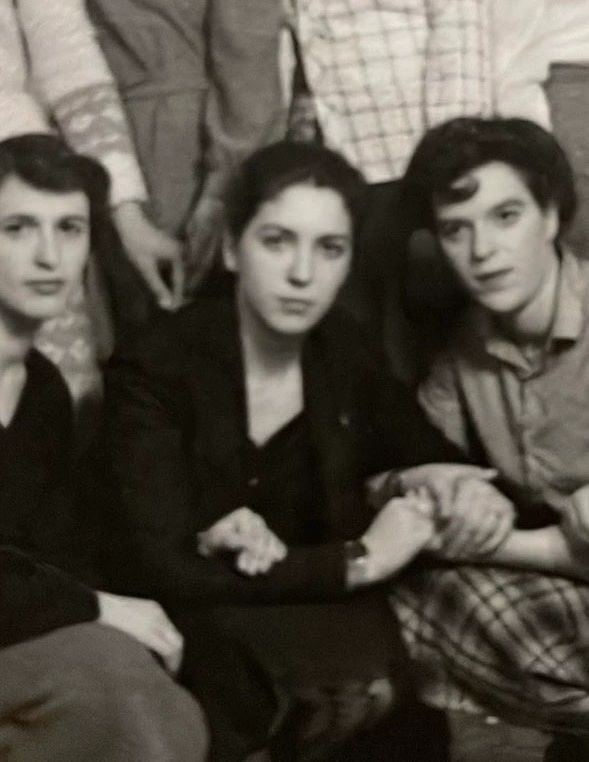
The experiences of women who migrated from Kosovo to the West during the 1990s or earlier remain largely unaddressed or marginalised in current Kosovar-Albanian migration narratives. With this in mind, we will begin periodic conversations with the generation of women who moved to the diaspora with their families or claimed asylum on their own.
To begin this series, I interviewed my mother, Ilirjete Agushi-Kqiku, to share her perspective on migration and the significance of leaving Kosovo with three children, to shed light on how this experience has shaped Ilirjete's life to this day.
Ilirjete Agushi-Kqiku was born in Gjilan, Kosovo, where she completed her A-Levels and attended a teacher training school, as it was known in former Yugoslavia. At the age of 32, with her husband and children, Ilirjete moved to Augsburg, Germany, where she now lives and works in gastronomy. Ilirjete speaks German, French, Bos/Cro/Ser and Albanian.
Interview transcript
Hi Mom, welcome to Diaspora Speaking! Thank you for accepting my invitation to hold this conversation today.
Thank you very much; I am very privileged to be part of this Podcast.
As a start, for the audience, can you tell us about yourself? Where are you from? Where did you grow up? And where did you emigrate to?
I was born in Gjilan and lived there for part of my life — until the age of 32. From there, I've been living in Germany for almost three decades. In Gersthofen, which is a small town near Augsburg.
You grew up in Gjilan at a time when Kosovo was still under the former Yugoslavia. For our audience, could you tell us more about your life, a personal impression, particularly the years up until high school?
We lived in former Yugoslavia; the communist system was a very restrictive structure for everyone, especially for us in Kosovo. We were constrained. And we didn't have the rights, for example, that the other republics of former Yugoslavia had. Kosovo was always oppressed. More than was ever talked about in the media or anywhere else, we all know this: all of us who experienced it. Yugoslav politics, for instance, tried to deceive you at times with a school, a university, or some language rights. But you didn't have the freedom that you should have had because there were consequences from earlier territorial politics.
For your family, this restriction was very particular, as a family that experienced decades of state repression.
My paternal family has been politically persecuted before, during, and after World War II. They were forced to leave their home, the village of Terpeze, where my father was born, my grandfather, and so on, and they came to Gjilan because politics persecuted them. They were taken away everything they owned. They were left with nothing but the spirits of the people, and my grandfather came to Gjilan with his sons. However, they were always persecuted. I mean, even after World War II and up until the last war in Kosovo, we were always a family that was under surveillance, treated differently, and persecuted. And this made it so that, for example, as a family, we were constrained, and we always had to be cautious. We always had to be careful, with the constant fear of what would happen and how it would happen. And so, the consequences of what could happen were known.
This had barriers in your daily life in many areas, such as education. I remember when you told us that you participated in a French language competition and won second place, receiving a prize to travel to France. Still, because of your family's history, among other things, you didn't receive funding for that trip.
Yes, just like now, when the 10th grade is calculated, back then, it was the second year of high school, and I participated in French language competitions. I qualified for the local competitions, which were regional back then, as was the case for Kosovo. With it, I secured second place and a three-week trip to France, to Paris. However, that visit to Paris was covered, and it was the prize that I won. But our conditions were difficult, we need to always acknowledge that, and other funds, for example, for travel and so on, we couldn't afford to cover them. The municipality back then, as well as the school and the principal, were not in a position to help; they ignored our request. I remember the time when I went with my father to the principal of the school to ask for help, but it was denied. It wasn't possible for a child of a worker to do something.
Even when you deserved it?
No, no.
After high school, during the 1980s, the situation for Albanians in Kosovo worsened, and the crisis deepened. Do you think that these experiences pushed the activism in different forms for you and Dad?
Yes, of course, because you were always, in everything you did, in every activity, you were restricted, and even though you didn't dare… You dared, you had the courage, people dared a lot. Albanians in Kosovo had a lot of courage, you always felt the isolation, more and more. That always made you fight harder, ask for more, and do more to have some freedom. Not just freedom for yourself but for the general freedom of the homeland.
I emphasised activism in different forms on purpose because I think what is lost in these discourses is the way or how women who experienced, I think, double oppression, how women were positioned that time.
What I wanted to say is that you have limited freedom, and you have the enemy in front of you. On one hand, you have the enemy, and now you have to acknowledge the existence of patriarchy as well. It's not because of women; women have raised their voices. Our women are very strong. That is undeniable. However, it has always been a limited freedom. We know the previous wars; we know our heroines, our women. But we also cannot deny, as a society, that patriarchy has existed.
Now, let's move a bit in time. Let's go forward to the mid-90s when we went together to Germany. I want to know about the decision to leave Kosovo. How long did you and Dad think about it before making that decision?
We never thought about leaving Kosovo. However, Halil was an activist. He worked tirelessly, without sparing anything, to promote the freedom of Kosovar Albanians in Kosovo, with the only aim of moving forward. As we know, he was an activist for the Reconciliation Council of Blood Feuds and helped those in need through the Mother Teresa mission. His activity started with the Parliamentary Party of Kosovo, and he contributed without stopping until he was arrested. After he was released from prison, the Serbian authorities at the time never left him in peace, and that's when the idea came up to leave. It was a period of three to four months. The decision-making was equal because, even when we made the decision, we didn't decide just by ourselves. We made the decision, with the approval of both families, that we would leave Kosovo. For example, we had children, and we knew the consequences of what could happen when an authoritarian state disturbs your peace when the authorities are watching you. So, we made the decision and left.
The main reason we emigrated was Dad's political activism, and yours as well, because I know you participated in many political activities together with Dad. Consequently, considering what could happen to the family, you decided to go to Germany. I remember that we travelled for about three weeks, and I know it is tough to re-live such a journey that stays with you for your whole life, but can you share some of your impressions during that journey?
Well, first, you left everything to live. To survive. You had seen and wanted just one thing: life. You wanted just life. And you didn't know what awaited you. For example, you had never been to Europe before; you didn't know Europe; you had only seen it on television. But you didn't know it. You didn't even know what you would go through during the journey, and when you got there, it was a completely different world for you. It was a different world, a reality that awaited you. When we arrived in Germany after that entire journey, waiting here, waiting there — not today, not tomorrow — people deceived us because, at first, they gave us hope that the journey would be very quick, but then we were left on the road. And you didn't even know where you were. But when you arrived in Germany, like everyone else, like all the other asylum seekers, it was all completely different for you. For example, in Kosovo, you had a structure to life, but there, you were very limited and with a completely different structure. And that bothered you at first. It bothered you because you didn't know the language; you didn't understand what was happening to you. Would you stay there, continue your life there, or go back to where you had come from? There were so many questions and confusion, and you didn't know. You had entered a sphere where everything about your situation was ambiguous. Your mind was always preoccupied, thinking: what's next, how, when, where will I end up?
You're describing it as if being in the air, in uncertainty. But for you, as a woman, what thoughts or impressions did you have during that journey — especially as a pregnant woman?
First of all, there was just fear. The entire journey was made with fear. You didn't leave Kosovo in a regular way when going abroad. And that fear stayed with you until you crossed one border, then another border — you travelled in constant fear. The foundation of your journey was the fear that accompanied you from the beginning. Then, you had the children with you. What's going to happen? For example, what if you get stopped at a border or get sent back? At the border, or when crossing the Serbian border, what will happen to you? The danger was very real. You had the children with you, which meant you were always faced with questions about where, how, and what might happen. There was so much uncertainty. You didn't know what would happen to you. You asked yourself many questions, but you were always under pressure and very unclear about everything. It was just a lot of fear.
When we arrived in Landsberg am Lech, the whole bureaucratic process of admission — can you tell us more about that part?
It was even more difficult when we arrived in Landsberg because you had left everything behind. And the German state accepted us, and we are grateful. However, at that time, I felt undermined; essentially, you had come and surrendered yourself to another state in Europe. You had left everything that belonged to you, your homeland, for which you had fought, and you came and surrendered to a state in Europe to live and have some perspective for your future.
When we arrived at the Landsberg asylum centre, you and Dad were interviewed. Do you feel comfortable sharing more about the interview process or the questions if you remember what they asked?
The questions were standard, like why you left your country. They wanted documentation to prove that you were politically persecuted, and we had all the necessary documents with us. We handed over everything, including all the court documents, the indictment against Halili, and everything we had when we arrived in Landsberg. We submitted them. The standard questions, as usual, focused on understanding the journey — how you got there, where you crossed, the details of your route. They were most interested in how we travelled and why we had chosen to come to Germany. Those were the main questions for everyone: why did you come, and why did you choose Germany? The documents spoke for themselves, so there wasn't much need for additional explanation; they were translated and processed. After six months, Halili was granted asylum.
I want to pause a bit on Dad's asylum case. When Dad's asylum was accepted, the rest of us received a negative response. At that time, we didn't know the system well or the language sufficiently, and we feared for us as a family that we might be sent back. We're talking about the mid-90s, and I'm curious how you and Dad experienced that news.
We didn't think about going back; returning was not an option. But when you're an asylum seeker, living in exile, especially in the beginning and in the period that follows, fear is always a factor that accompanies you. We didn't think about going back; instead, we thought there had to be another way because returning was not an option [absolutely not]. You try to find an alternative path, even if it takes time, especially since you don't know the language. You didn't know then, for example, that family reunification might be an option. You might have thought so, but you were in a foreign country where you didn't know the laws and rules of that state. Even today, you might not know all the laws. Halil was accepted, and he had his case secure; we thought there might still be a chance they could send the rest of us back — me and the children. So, we hired a lawyer. The lawyer did his job, even though he told us the family reunification process wouldn't take long. But even then, it still ended up taking nearly five years.
Let's ponder on the fear and the language barrier. As mentioned earlier, when we arrived in Germany, you were pregnant, and after six months, you gave birth to Lumi and Bardhi. It was a very complicated birth, to the point where you didn't know if you were going to survive or not. And throughout this entire process, you didn't speak the language. You didn't have any means of communication with the medical staff. In those critical hours, you truly didn't know what was happening to you.
When you go to a different country, you don't know the language. The language is the key. But for example, you can't learn the language that quickly in a few months, four or five months. When I went to Germany and heard German, I thought to myself, 'I can't learn this language.' I started getting nervous; it hurt me. I thought, 'I can't do this. What kind of language is this?' Anyway, time passed, and I went to the hospital. The conditions were completely different; everything was in order, but my process was different. There was a quick reaction in the hospital and the operating room. At that moment, you think only about your children. Where, where are they? I knew Halil was very strong, but the children were small; where would I leave them? The fear is 'where, how..?' In this foreign country, you still don't know the place. You just arrived. You don't know the place, you don't know the language, you don't know anything. So, you constantly have fear at every step. Fear became your friend; you carried it on your shoulders.
Fortunately, Germany had a more developed healthcare system, and the worst didn't happen. Now we're going to move a few steps forward and talk about when Lumi and Bardhi started going to kindergarten or preschool, and you started working. Even though you didn't know the language, you went to work.
Yes, Lumi and Bardhi came into our lives. And it's normal; they were young, and for the first three years when they were little, I didn't work. I want to thank you all very much when they started going to daycare. You three cared for the children when I went to work. They started going to daycare, and I started going to work. At that time, the opportunities were different, and when I worked, you took care of Lumi and Bardhi. If it weren't for you,…we both had to work. The opportunities were smaller because I couldn't leave the children alone, close the door, and go to work; that's the reality. When I started working, I didn't know German. I understood a little, but I remembered words, and when I came home, I would ask you the meaning of the words. You often told me, 'Yes, Mom — how was the word said?' Because a word, when spoken, could have different meanings. And then, I would explain it like that. I couldn't explain the whole situation, but approximately, based on what you showed me, I learned the language by asking a lot. Even today, I still ask you.
Yes, but today, you speak well.
But there is still much that I don't know.
This shows that the challenges you faced as a woman have been multifaceted.
For example, now we revert to the activism part. Even when we arrived in Germany, the situation in Kosovo was not calm. When we arrived in Germany, Halili started working after a year, and after three or four years, I also started working. When we both started working, Halil continued his activism outside of work. He was always connected to Kosovo and always engaged in activities for his country. He had meetings with people in the diaspora; many people came to our house. Activism was part of our home that continued after working hours. He would finish his work hours, but he was always connected to the country and Kosovo. He always did his work and contributed to Kosovo from here, from the diaspora. Even back then. But a person couldn't be both here and there, but he contributed from the diaspora. So, I took care of the household, went to work, and looked after the home. But when you do something for the country, you do it with love. You do it for a great purpose, for Kosovo, for our country; this covers everything.
You mentioned Kosovo. After a few years in Germany, and as you mentioned earlier, the process of getting our documents sorted, after receiving a negative response, and after the war ended, we went to Kosovo for the first time. Can you tell us how you experienced that visit?
It was truly heart-wrenching. Very painful. Why? After five years, when you go back to Kosovo. You always hope that you will go, you will go, you will go, and when we arrived, we didn't expect to stay here. Everyone thought there were many people who had gone into exile, thinking they would return as soon as possible. Because life in Kosovo would improve, and we would return to our homeland. We would be in our country. But when I went back after five years, it was very hurtful. Just one word. Heart-wrenching. Because you feel like you are in a neutral zone. You have now been placed in another country. I'm not saying you are comfortable, but now you live your life.
It has been 30 years, and you have gained German citizenship. You mentioned that Kosovo always hurts, but after 30 years, something must have changed. How do you think your relationship with Kosovo has changed over time?
My relationship with Kosovo hasn't changed much. But when I left Kosovo, I left it in one way, and when I return today, I find it in a different state. Today, Kosovo, thank God, has achieved independence and developed. It has developed well now; we can't say that Kosovo hasn't developed. The war has its consequences, but Kosovo has developed, though it still needs a lot. For us who are not there, we've built a life here in Europe. We go to Kosovo, stay, come back, and enjoy going. I always enjoy going.
Do you think about returning permanently to Kosovo later?
I am thinking about visiting Kosovo and living there. It's not a question of whether I can or not. Yes, I can live in Kosovo. But my family is not there. My family is in Kosovo, but my children are all in Europe. Now, my children have experiences in Europe. They are developing, they have been educated, they have completed higher education here. They also have jobs here. They have a life perspective in Europe. They live here; they are settled here. So, I can't go and live in Kosovo for one year; I would go to be with my children. Both here and there. A little here, a little there (laughs).
Better here or there?
Both here and there.
As a conclusion to this conversation, a question I ask every guest who comes to Diaspora Speaking or to "Diaspora Flet" is: If you could bring one thing from Kosovo to the diaspora that is missing for you, what would it be?
What I would take and what I would want, even though we speak Albanian sufficiently here, still, we don't touch on all the words. I would take the complete dictionary of the Albanian language, so when you speak, you would have the opportunity to touch all the words.
This ending makes you think about the language and life in the diaspora. Thank you very much, Mom, for accepting my invitation to be a guest on Diaspora Speaking. This conversation is the most important interview I have conducted so far. Thank you very much.
Thank you; it was an honour. Thank you so much, and I wish you good health. I wish you much success with the podcast!