
Diaspora Speaking Archive
The 1990s Refugees and Immigration
The wars of Yugoslav dissolution created one of the largest refugee crises in post-war European history. This is an account of what that displacement looked and felt like from the inside.
Context
A continent in motion
Between 1991 and 1999, the dissolution of Yugoslavia produced a series of armed conflicts that displaced millions of people across the Balkans and beyond. Slovenians, Croats, Bosniaks, Serbs, Kosovar Albanians — entire communities were uprooted, some more than once, as borders shifted and violence followed.
By the end of the decade, an estimated 2.2 million people had been permanently displaced from their homes. Many ended up in Western Europe — Germany, Austria, Switzerland, Sweden, the United Kingdom — where they arrived not as economic migrants but as refugees, carrying the particular weight of people who did not choose to leave.
This piece does not attempt to give a comprehensive account of those wars. It attempts something smaller and harder: to trace what displacement felt like from the inside, through the testimonies of people who lived it.
"We left with one suitcase. My mother put in photographs first, then documents, then clothes. She knew what mattered."
Testimony collected, Vienna 2024
The first wave: Slovenia and Croatia, 1991
The Ten-Day War in Slovenia and the subsequent conflict in Croatia produced the first major displacement of the decade. Croatian Serbs fled westward; Croats fled eastward and then north. The patterns were chaotic, driven by local violence rather than central policy, and the international community was slow to respond.
Many of those who fled in 1991 believed they would return within months. They did not pack for permanence. They left furniture in place, left pets with neighbours, left unfinished meals on tables. The assumption of return shaped everything — the temporary accommodation they accepted, the languages they did not learn, the communities they did not join.
Bosnia, 1992–1995
The Bosnian War produced the largest single displacement of the decade. By 1995, more than half of Bosnia's pre-war population of 4.4 million had been displaced — roughly 1.2 million as refugees abroad, the rest as internally displaced persons within the country's new, contested borders.
The Bosnian diaspora that formed in these years was scattered across dozens of countries, with particularly large concentrations in Germany, Austria, Sweden, and the United States. Unlike earlier Yugoslav labour migrants, these communities arrived with the specific trauma of siege, ethnic cleansing, and the particular grief of people who had watched their cities destroyed.
Many Bosnian refugees in Germany were granted only temporary protected status — Duldung — which meant years of legal uncertainty, restricted work rights, and the constant threat of forced return. The psychological toll of that uncertainty is only now beginning to be documented.
Kosovo, 1998–1999
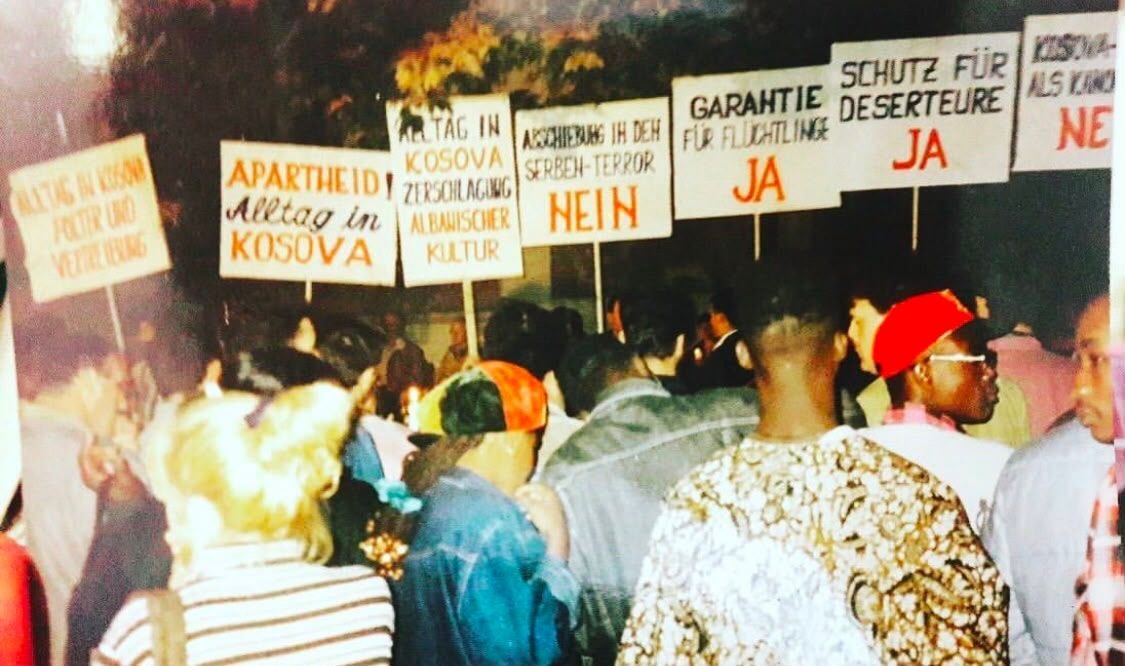
The Kosovo War of 1998–99 produced the fastest mass displacement of the decade. In the spring of 1999, following the NATO bombing campaign, approximately 850,000 Kosovar Albanians fled to Albania, North Macedonia, and Montenegro within a matter of weeks. A further 590,000 were internally displaced.
The speed of the Kosovo displacement meant that many families were separated in the chaos. Children were evacuated without parents; parents fled without knowing where their children had gone. The reunification process that followed was slow, painful, and in some cases never completed.
For the Kosovar Albanian diaspora already established in Western Europe — many of whom had left in the late 1980s and early 1990s under Milošević's repression — the 1999 crisis brought a new wave of relatives, often traumatised, often with nothing, into communities that were themselves still finding their footing.
"The hardest thing was not the leaving. It was the not knowing whether there was anything left to go back to."
Testimony collected, Berlin 2025
Memory and the archive
The 1990s refugee crisis produced an enormous volume of documentation — UNHCR reports, NGO assessments, journalistic accounts, legal proceedings. What it produced far less of was first-person testimony from the people who lived through it, recorded in their own words, on their own terms.
The Breaking Archival Silences project is one attempt to address that gap. We are collecting personal testimonies, family documents, photographs, and objects from people who were displaced in the 1990s and from their descendants. We are building an archive that centres the experience of displacement rather than the politics that caused it.
If you or your family were displaced during the Yugoslav wars, we would like to hear from you. Your story belongs in the record.
Breaking Archival Silences
Do you have archival material to share?
Learn more about the Breaking Archival Silences project.